We’re into July already and the summer flow is full on with Bramble and Lime in bloom. The warm, sunny weather has helped to stimulate nectar production, and plants or trees with deep roots can still find plenty of moisture. Other sources may soon start to suffer from drought stress and stop producing nectar unless we some have rain.
In the Teaching Apiary we have taken off the spring harvest and, I suspect, the beginning of the summer crop. The honey we have extracted is medium/dark in colour with a good nose and a very persistent, complex flavour in the mouth, possibly due to the amount of Horse Chestnut the bees have foraged. When we took off supers of honey we replaced them with empty ones to give the bees space and avoid overcrowding.
Any profit from honey sales this year will help to offset the cost of setting up the apiary, and towards the cost of equipment and consumables such as feed supplements, varroa treatment and foundation.
It’s still not too late for colonies to swarm so we are being vigilant during weekly inspections, keeping a sharp lookout for the signs of swarm preparation, creating space for the queen to lay and for the foragers to bring in their bounty. Remember one frame of brood produces three frames of bees and the foragers who are out at work all day need somewhere to sleep at night.
With the threat of European Foul Brood (EFB) on our doorstep in Hampshire we are paying careful attention to apiary hygiene and examining every brood frame for signs of something amiss with the larvae. Collected swarms from an unknown origin are a risk and should be kept away from other colonies until they have a clean bill of health before being installed in an apiary with other colonies. Just as a reminder here’s a shot of an infected comb so you know what to look for.
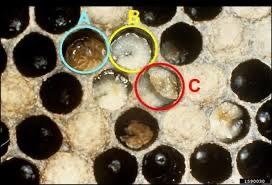
European Foulbrood
When the disease first strikes there may be only one or two larvae affected and is very easy to miss.
There are a lot of wasps around already. They are normally in the carnivorous stage of their life cycle and don’t start scavenging for sugars until late summer or early autumn, but these are after anything they can get. Wasps can rob out a weak colony very quickly, so we need to ensure that our colonies and nucs have a lot of bees to fight their corner, uniting weaker units if necessary and reducing entrances to the smallest setting.
We still have time to raise some new queens. An easy way is to do a split from a strong colony into a nuc. The nuc will have time to build up a good-sized population before winter. In the teaching apiary we will be doing a batch of grafts on Sunday 13 July and hoping for good weather when the new queens emerge and embark on their mating flights.
Now is a good time to think about uniting weak colonies, to have a big foraging force for the summer nectar flow, and for going into winter. Weaker colonies are always at risk of winter failure, so it is better to have one colony that survives than to have two that perish before next spring.
Varroa populations will be building up at an alarming rate now. We are testing all our colonies using the CO2 method and taking appropriate action to reduce the varroa load if the test result is greater than 1%. Testing for Varroa Sensitive Hygiene (VSH) behaviour continues. We have one promising colony from which we’ve taken a split to continue the genetic line. If they continue to show resistance, we will take some grafts and produce more queens with this trait.
Thank you to everyone who has supported the teaching apiary this year so far and well done those of you who passed the Basic Assessment this year.
Good luck with the rest of the season and happy beekeeping!
Alan Baxter
2 July 2025


Leave a comment