Winter is upon us, and we have tucked up our colonies for the colder weather. Here on this corner of the south coast we enjoy a little microclimate, sheltered by the South Downs to the north, the Isle of Wight to the south-west and the moderating influence of the Solent. Frost and snow are rare and spring comes early.
The garden is still full of colour and foraging opportunities for the bees on fine days. Showy Fatsia are still in bloom, the flowers are out on the delicate Virgin’s Bower, cheeky Daphne odora with its tiny petals and powerful perfume, prickly Mahonia, shy Hellebores and classy Cyclamen are all showing off their charms, whilst the Skimmia is full of red berries ready for our Christmas wreaths which we made a few days ago.
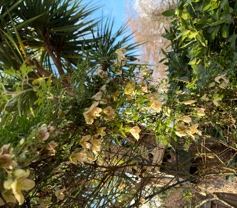

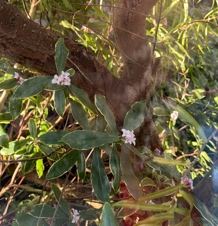

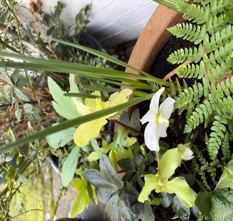
Virgins bower · Fatsia · Daphne ordora · Mahonia · Hellibore
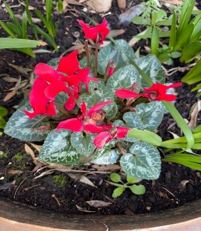
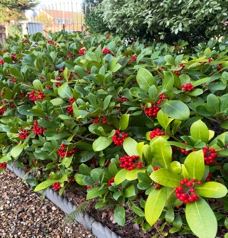
Cyclamen · Skimmia
The seasons are overlapping with early spring species arriving before the autumn has finished. The hazel is full of catkins ready to shed their showers of protein-rich pollen while an optimistic Primula is risking a smile in time for Christmas.
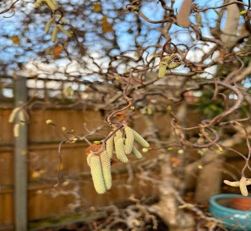
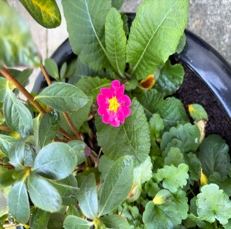
Hazel · Primula
This is good news for our energy bills, but it poses problems for beekeepers. It means there can be little or no brood break, an important interval in the varroa life cycle when the mites have nowhere to lay their eggs and raise their young.
During a brood break all the mites are living and feeding on the adult bees in what is known as the phoretic* stage of their life cycle. This is when we can apply Oxalic acid to selected colonies. In my teaching apiary we are experimenting with selecting colonies for varroa sensitive hygiene behaviour to evolve into treatment-free, so we are ‘reading’ the varroa boards closely to observe the mite drop, evidence of brood cell uncapping and cannibalised pupae remains. There is much more to be learnt from the varroa board including dropped pollen loads, wax flakes or particles of sugar indicating the position of the cluster, how active the bees are in hive cleaning and uncapping stores or eating fondant.
The colonies that still have a high level of varroa have been treated this week with Oxalic acid using my new InstantVap battery-powered vaporizer. First impressions are good, the delivery is fast, but I found that the load on the battery is heavy, so you need to have a spare one on hand. The business end gets very hot so you need to wear thick gloves when refilling the charger.
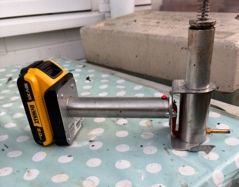
InstantVap
Winter is a good time to take stock of the year’s work, review our hive records, and start planning for the coming season. January sales offer opportunities to get a good price for new equipment, whilst Fareham Beekeepers have a sale of used kit at the first meeting of the new year. Spring can be upon us before we know it and we can be caught hopping if we don’t get on top of our routine maintenance tasks.
Thank you to all the members who have supported our teaching apiary this year. I will see some of you on Zoom for the series of Module 3 Study group sessions starting on 11 January at 19.00 and hope to have the pleasure of helping you on your beekeeping journey again in 2026. I will publish the training programme for the year shortly.
Finally, Penny and I wish you all a very merry Christmas and a Happy New Year
* The preferred term nowadays is the dispersal phase
Alan Baxter
Education Officer
Fareham & District BKA
13 December 2025


Leave a comment