The swarming season has been particularly intense this year due to a long, cool spring followed by a sudden spell of warm weather. Although the worst seems to be over there are still some swarms around and the season is by no means over so there is no room for complacency.
In an earlier blog I talked about the basic theory of swarming and some of the measures you can take to prevent or control it. In this paper I’ll expand on the mechanics and timings of swarming, the differences between prevention and control and the precautions to take against casts or secondary swarms.
In order to deal with the ever-present threat of losing half your bees and terrorizing your neighbours, it’s useful to understand the swarming process, the key indicators to look out for and the prevention or control measures you can take.
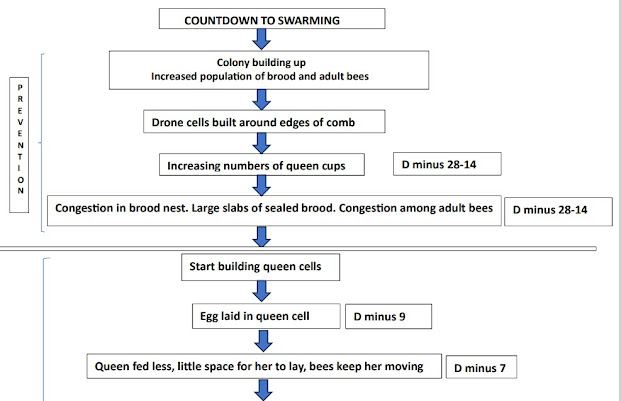
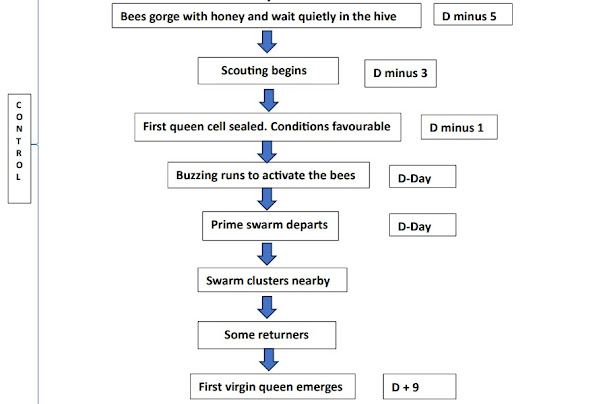
In the chart below you will see the progression that occurs. I’ve divided it into two parts – the times when you can take prevention measures, and those when control is necessary.
Prevention
Prevention requires regular, thorough inspections and careful observation, at least weekly unless your queens are clipped in which case every 10 days will do. Anticipate and act are the key words.
Here are some simple but effective measures you can take:
1. Mark your queens
- If you can’t find the queen get another pair of eyes or two to help you
- The earlier in the season the better when there aren’t too many bees
- Do it in the warmest part of the day when the maximum number of bees are out foraging
- Or move the brood box to one side and put a super on its original stand to divert all the flying bees and give you more room and quiet to look.
2. Clip your queens. This involves gently cutting off the end third of one wing. It isn’t to everyone’s taste but there are no nerves or blood vessels there – it’s like cutting your toenails.
If you’re struggling with any of these, get a more experienced beekeeper to help you. People are always happy to lend a hand.
3. Give them more space by adding supers early
- The bees need room to live and to store incoming nectar and pollen
- Nectar contains about 80% water and requires a greater volume of space than honey which only contains 20% or less
- The queen needs more space to lay her eggs
- Add a super as soon as the brood box starts to look crowded. When the flow starts they will be bringing in nectar very fast
- If there are no supers they will store nectar in the brood box, thereby depriving the queen of laying space and the workers of living room
- Remember that during the day, a lot of the bees will be out foraging. At night they need somewhere to sleep
- Replace surplus frames of honey with drawn comb or foundation
- Replace damaged comb which can’t be used efficiently
4. Have your equipment ready in advance to take off the pressure when the time comes to act.
Control
Once the queen cells have been formed, the time for prevention has passed and control measures are needed. I prefer to use either the nuc or the Pagden method if I want to make increase from the colony, or the Demaree technique if I don’t want any more hives or to breed from that particular queen. All three are described in my earlier blog or can be found on numerous websites and on YouTube.
Beware the cast or secondary swarm
After the first swarm has issued, all the sealed brood that the queen had been producing in the period before the swarm will start to emerge (remember those big slabs of brood about 3 weeks ago?). This could mean that newly-emerged virgin queens might trigger another swarm.
To reduce the risk of secondary swarming:
- remove all the sealed queen cells
- choose the best two unsealed ones, marking their position on the frame with a drawing pin
- One week later go back and remove any more queen cells that have been made and
- remove one of the marked ones
- Make notes in your hive records of the dates – it can take longer than you think for a new queen to be mated and start to lay.
Don’t be beguiled into thinking that your colony haven’t swarmed because the hive is still full of bees – it’s all that brood emerging after the main swarm has left.
If they have swarmed, treat it as the parent colony and remove all the queen cells except one. Don’t be tempted to leave a second one as belt and braces.
Happy beekeeping!
Enormous thanks to Christine Coulsting, Master Beekeeper, for her excellent guidance on this and many other topics.
by Alan Baxter


Leave a comment