Many beekeepers suffer colony losses in winter and early spring and wonder what happened. Most losses are avoidable so let’s have a look at some of the common reasons why colonies die out, how we can prevent it and what we can do to help colonies that are vulnerable.
Health
It is important to carry out a full health inspection of the adult bees and the brood after the summer harvest. A health inspection is a visit to the colony in its own right and not combined with other work. Learn to recognise what healthy bees and brood should look like, and how to detect when something is wrong. The BBKA pocket guide on honey bee health is an excellent addition to the beekeeper’s tool kit.
Starvation
This happens when the colony runs out of food and there is no foraging to bring in stores. This could be because:
- the beekeeper was greedy and took all the colony’s honey the previous summer.
- a genetic factor whereby the bees naturally eat a lot of food.
- a mild winter when the bees are very active and need more food for work.
- The queen continues to lay and more food is needed to feed the larvae.
- There are stores but the bees cannot reach them (isolation starvation).
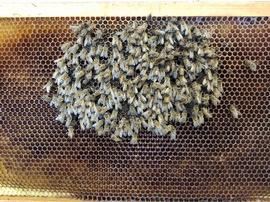
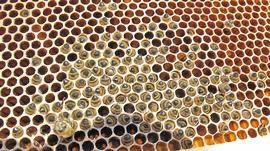
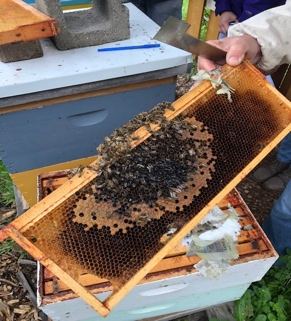
Winter starvation no food Bees with head in cells Spring starvation. Brood but no food.
Prevention
- Ensure you leave enough stores for the winter. An average colony needs about 20kg of honey to last until the following spring. That means several frames of capped stores in the brood box and at least one full super.
- If they have less than this in October, feed with 4 litres of thick sugar syrup.
- Remove the queen excluder so the cluster can go into the super and not leave the queen behind to die.
- Heft the hives every 2 weeks and top up with fondant if needed.
- Give pollen supplement e.g. Candipolline and fondant in February to provide nutrition for the larvae and to stimulate the queen to lay.
Varroa
If the varroa load is high it will bring stress on the bees in winter by feeding on their fat bodies and exposing them to fatal viruses such as Deformed Wing Virus (DWV) or Chronic Bee Paralysis Virus (CBPV).
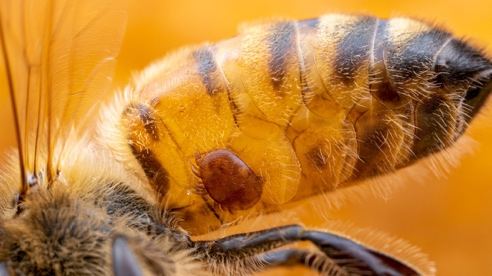
Varroa feeding on adult bee
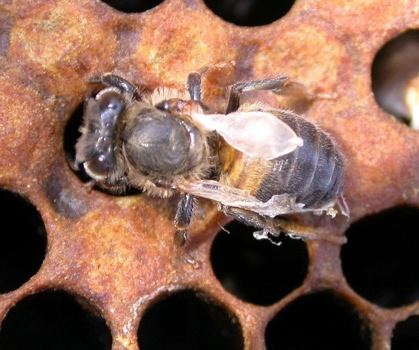
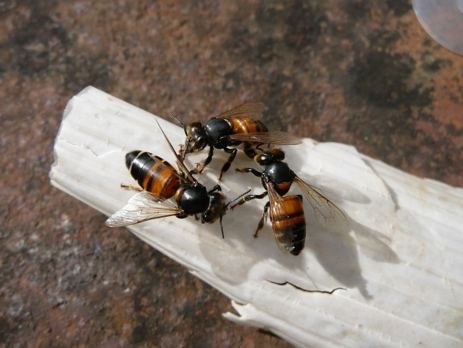
DWV CBPV
Normally in winter there is a period of no brood, and the mites cannot reproduce. If the winter is mild and the queen keeps laying, there is no brood break, the mites continue to reproduce in the brood cells and to grow exponentially.
Prevention
Varroa treatment in late summer and in early December, followed by monitoring to check the success or not of the treatment, must be carried out strictly in accordance with the manufacture’s instructions and recorded on VM2.
If the numbers of varroa in summer are too high, the population of mites will continue to grow as the number of bees declines, to the point where the colony is overwhelmed. See fig 1 below:
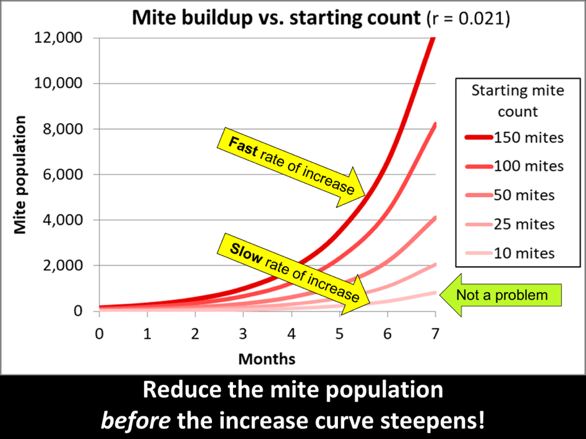
Fig 1Graph courtesy of Randy Oliver
Small colonies
If the colony going into winter is small, they won’t have enough bees to look after the queen and to keep the brood nest warm. The queen will die and the colony will dwindle and perish.
Prevention
In autumn, unite weak colonies that have less than 5 frames of brood or put them in a nuc which is easier to keep warm. Give stimulative feeding of thin syrup in September to encourage the queen to produce more winter bees, then thick syrup to lay down as stores.
Queen failure
A colony that loses its queen in autumn or winter won’t be able to replace her with a new mated queen and the colony will dwindle and die.
Prevention
Change queens that are more than 2 years old for a new queen. If the old queens are good ones and you can’t bear to part with them, ‘retire’ them to a nuc and use them for breeding new queens next year.
Always use locally bred queens from stock that is adapted to the local environment. Buying queens imported from another country or a different part of the UK is a recipe for failure.
Nosema
If nosema is present in summer, the bees can defaecate outside the hive and, in a strong colony, the disease will often go unnoticed. However, nosema reduces the bees’ ability to absorb protein, so the bees are weaker and have shorter lives. Come autumn and winter the bees are confined to the hive, the spores spread more quickly, the number of bees is reducing but the nosema spores keep increasing, leading to winter losses or failure to build up in spring.
Prevention
Test for nosema after the summer honey harvest. Send a sample of about 30 bees to a laboratory or a beekeeper who has microscope, for testing. Alternatively, kill a few bees and pull out their intestines with fine tweezers. The midgut should be yellowy-brown, if it’s white and fragile nosema is probably present.
Remedy
There is no treatment. The spores are deposited in the comb, so put them on clean comb using the Bailey comb change for a weak colony procedure, then feed them with 2:1 sugar syrup and pollen supplement and hope for the best.
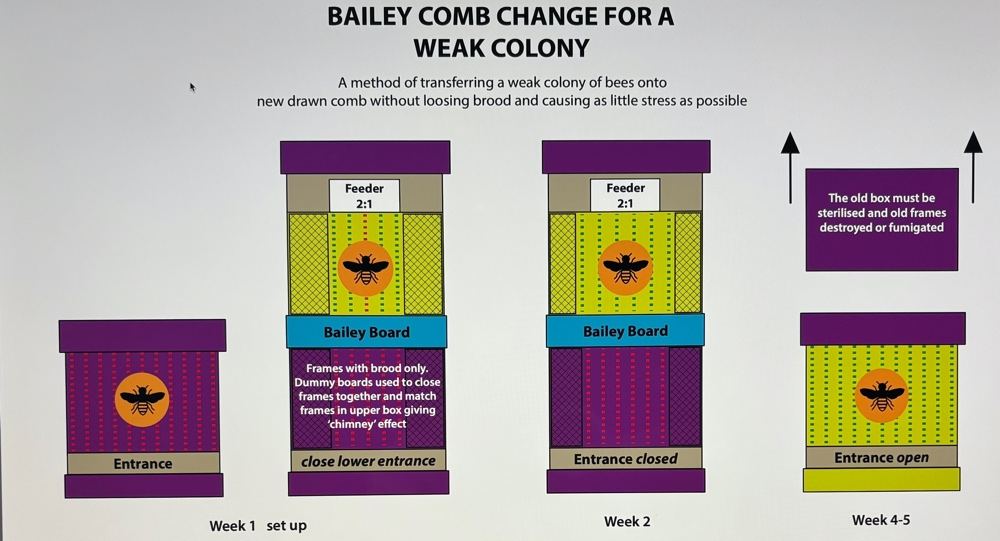
Equipment:
- Clean brood chamber containing frames of sterilised drawn comb
- 4 Dummy boards
- Queen excluder and eke with entrance block or a Bailey Board.
- Crown board
- Floor
- Contact feeder and 2:1 sugar syrup.
Method: Day 1
- Take the frame with the queen on and place it in the new brood box.
- Remove all frames without brood from original brood box and any supers.
- Close up the remaining frames in the centre of the brood box with dummy boards.
- Put frames of new drawn comb in the new box on either side of the frame with the queen.
- Match the number of drawn combs with the number in the bottom box.
- Close up the space in centre of the new box with dummy boards.
- Put a queen excluder and an eke with an entrance block (or a Bailey Board if you have one) on the old brood box.
- Close the lower entrance.
- Place the new brood box with clean drawn frames above the lower brood box.
- Put on the clean crown board.
- Feed with 2:1 sugar syrup.
- Add the roof.
- Dispose of the old comb by burning.
- Scrape and disinfect by scorching the old frames.
Day 7
- The queen in the upper box should have moved onto the new frames and started to lay.
- Remove the old frame with the remaining brood and return it to the bottom box.
- Add more drawn sterilised frames to the new box and close up with dummy boards.
- Check lower box for queen cells and remove if found.
- Remove any frames that have no brood.
- Dispose of the old comb by burning.
- Continue to feed.
Day 7-28
- Add a few more drawn sterilised frames in the top brood box.
- Remove frames with no brood from the bottom box.
- Dispose of the old comb by burning.
- Replenish the feed.
Day 28
- Place a clean floor on the stand and add an entrance blocker.
- Put the upper box on the new floor and adjust the entrance.
- Add a queen excluder then the super(s).
- Close the hive with the clean crown board and the roof.
- Remove, scrape and disinfect the old queen excluder and upper entrance or Bailey Board, lower brood box and old floor.
- Dispose of old comb by burning .
Alan Baxter
20 February 2025
Further reading: The Beelistener – Ann Chilcott’s beekeeping site, with articles and research summaries on bee health, varroa and winter survival.


Leave a comment