“In the world of the honey bee there are only 2 seasons, winter and preparing for winter” Anon
Introduction
The honey bee colony builds up to its maximum foraging force in July for the summer flow when it must accumulate enough food stores to last for the next 7 or 8 months. The population of ‘summer’ bees rapidly declines from July onwards until there only remains a small number of ‘winter’ bees.
Unlike summer bees, who live for 5 or 6 weeks, the winter bees are physiologically different from their sisters and can live for up to 6 months. Their job is to keep the queen alive and ready to start producing brood again in a few months’ time, as well as to feed the spring larvae. Colonies can be lost in the spring when not enough winter bees have survived to keep the colony alive. The more winter bees, and the longer they live, the greater the chance of the colony surviving into the following year.
The reason the winter bees live longer is complex and controlled by a multitude of internal and external factors, but in essence it is because their fat bodies contain large quantities of Vitellogenin, a protein that regulates honey bee longevity, immunity and temporal polyethism (the age-related division of labour) in the colony.
Why the winter bee can revert to being a summer bee again still represents an open question. (Knoll et al 2020)1
Winter stores
The average colony is estimated to need about 21kg of honey to avoid starvation. Happily for us, the bees usually collect more than they need and the surplus provides us with the delicious honey that we enjoy so much. If we take more, or if the bees haven’t collected enough, we need to replace it with some form of artificial feeding, usually in the form of sugar syrup, pollen supplement or substitute, and fondant.
We know that it is better to leave them enough of their own stores rather than feeding them sugar. Honey contains all the nutrients and trace elements that bees need for good health and long life. Sugar is junk food in terms of its nutritional value.
As a rough guide:
1 fully capped super = 12 kg
3 capped brood frames = 9 kg
Total 21 kg
If you leave the bees with a full super, it’s important to remove the queen excluder so the queen isn’t isolated when the cluster moves into the super. Whether the super is placed under or over the brood box doesn’t seem to make any difference, although bees will often prefer to move upwards, so it could be argued that above is better.
In some cases, the cluster will not move up and over the top of the frames to reach the stores in nearby frames and the colony dies in what is known as isolation starvation. Communication holes made in the brood comb by the beekeeper can help the cluster to move more easily laterally from one frame to the next.
Stimulating the queen to lay
Worker bees born in June and July will die in August and September, but those born after the beginning of August need to live until next spring. It is vitally important therefore that the queen continues to lay after the summer peak to produce plenty of healthy, well-fed winter bees.
In the past it was thought that feeding of thin 1:1 sugar syrup, and pollen patties in September to simulate a nectar flow would stimulate the queen to keep laying.
However, we’ve learnt that feeds of pollen supplements or substitutes don’t reach the nurse bees who need it to produce nutrient-rich brood food and its benefits are nugatory (Matilla et al 2007). And this is why:
- Substitutes and supplements stimulate brood production but are lacking in some proteins, amino acids, sterols, lipids and micronutrients
- This creates a nutrient demand that neither the substitute or supplementary feed can meet.
- The nurse bees draw on the colony’s reserve to make up the shortfall.
- When reserves run out, brood cannibalism can follow even if the colony is being fed (Schmickl & Crailsheim 2002)2.
It is has been found that a rich supply of diverse pollen in spring and autumn is required to maximize the production of long-living healthy winter bees (Maidarni et al 2025)3
Health
A thorough health inspection after the supers have been taken off to identify any adult or brood diseases which can then be treated, hopefully in time.
Varroa – the number one cause of winter losses
Varroa infestation, and the effects of the viruses transmitted, are the main causes of winter losses and must be treated at the right times of the year: get the timing wrong and the winter bees which are essential for the survival of the colony, will be compromised. (Martin S J 2001)4
Why mite infestations during August are much more damaging than similar infestations earlier in the year:
In spring and summer:
- colonies compensate for worker losses through continuous brood production.
During autumn:
- egg laying declines
- brood nest contracts
- queen activity decreases
- replacement workers are no longer produced in sufficient numbers to replace losses
One factor to consider is the size of the colony. We’re encouraged to build big, strong colonies, but paradoxically, it’s the big, strong, healthy-looking ones that can be the most vulnerable (van Dooremalen & van Langevelde 2021)5
Why Size Matters
One of the major research findings is that having large colonies is no guarantee of winter survival. Large colonies possess several characteristics that favour rapid mite population growth.
- Greater brood area.
- A large colony may maintain 8–12 brood frames with 30,000–60,000 capped brood cells.
- Each capped brood cell provides an opportunity for Varroa reproduction.
- The reproductive potential of the mite therefore increases in proportion to brood availability.
- Longer brood season
- Strong colonies often continue raising brood later into autumn.
- This extends the reproductive season for mites.
- Small colonies often reduce brood production earlier, shortening mite reproduction.
- More drone brood
- Strong colonies usually produce more drone brood earlier in the season, contributing substantially to the late-summer mite burden:
- Varroa prefer to invade drone cells because drones remain capped for approximately 16 days compared with 12 days for workers.
- Longer drone development allows:
- more sexually mature, mated varroa females
- higher reproductive varroa success
- faster mite population growth.
Consequently, colonies with abundant brood can experience exponential increases in mite populations during July and August with increased viral loads and progressive damage to the winter bees.
Why Large Colonies Often Look Healthy
Large colonies can maintain:
- large adult populations
- good brood patterns
- normal nectar collection
- normal pollen intake.
Meanwhile:
- mite numbers can increase
- virus prevalence can increases
- developing winter bees can become progressively damaged.
- The colony therefore appears healthy while its future workforce may be being compromised.
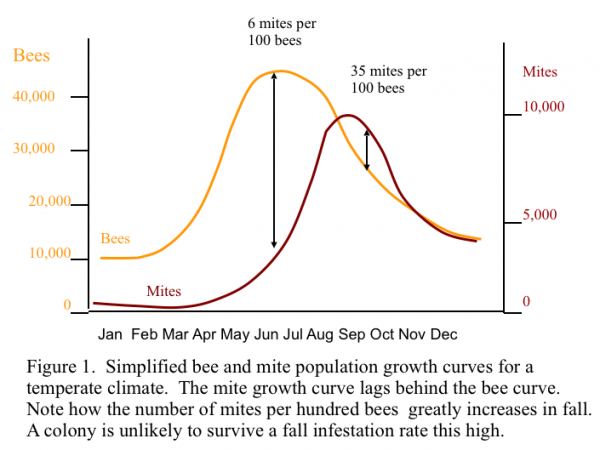
Source: Scientific Beekeeping6
Varroa Damage to Winter Bees
As we’ve already seen, winter bees differ physiologically from summer workers.
They have:
- enlarged fat bodies
- high vitellogenin concentrations
- increased nutrient reserves
- enhanced immune function
- longer lifespan.
These adaptations allow survival until spring.
Winter bees are produced mainly from brood laid during August and September.
This timing coincides with peak Varroa populations.
Effects of Varroa on Developing Winter Bees
- Varroa feed primarily on the honey bee fat body rather than haemolymph.
- The fat body functions similarly to the vertebrate liver and adipose tissue combined.
Mite damage can cause:
- reduced nutrient storage
- impaired detoxification
- reduced immune competence
- impaired overwinter metabolism.
At the same time, mites transmit viruses including:
- Deformed Wing Virus (DWV)
- Acute Bee Paralysis Virus (ABPV)
- Kashmir Bee Virus (KBV).
High mite populations can produce a non-linear increase in virus transmission.
Once mite densities exceed critical thresholds:
- DWV concentration levels dramatically
- increasing numbers of pupae become infected
- adult longevity falls rapidly
- colony resilience decreases.
Winter bees emerge:
- physiologically ‘older’
- with shortened lifespan
- less capable of thermoregulation of the brood nest
- immunocompromised.
Therefore, virus amplification is one of the principal mechanisms linking mite population growth with winter mortality.
The interaction between colony size and mite growth can create a delayed collapse.
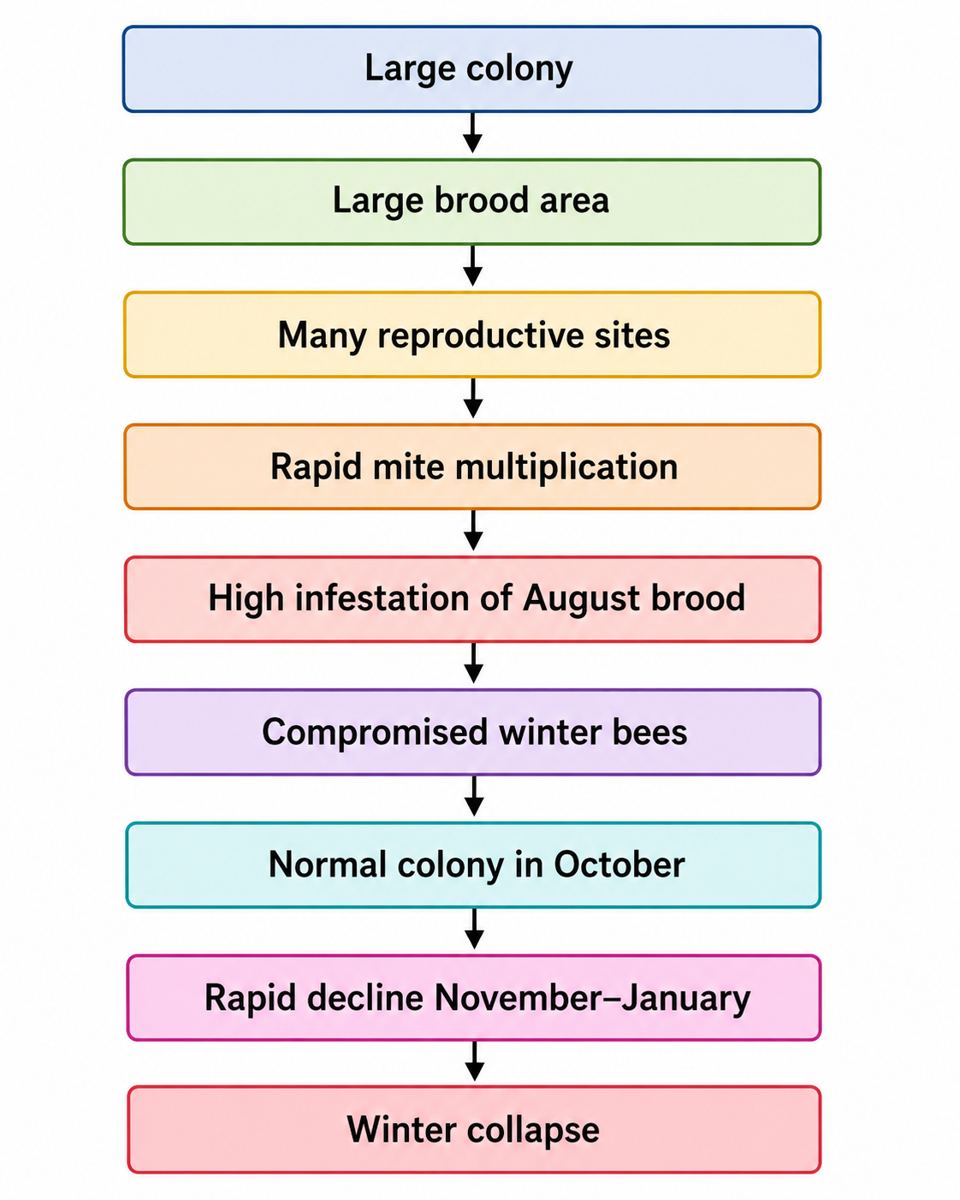
The delay between infestation and collapse explains why visual inspections often fail to detect colonies at risk.
Why Timing of Treatment Is Critical
The objective of late-summer treatment is not primarily to save the current adult bees, it is to protect brood destined to become winter bees.
If treatment is delayed until October:
- mites may be removed successfully,
- but many winter bees have already developed under heavy parasitism.
- the damage is irreversible.
This may explains why colonies treated "successfully" in autumn may nevertheless die during winter.
Conceptual Model
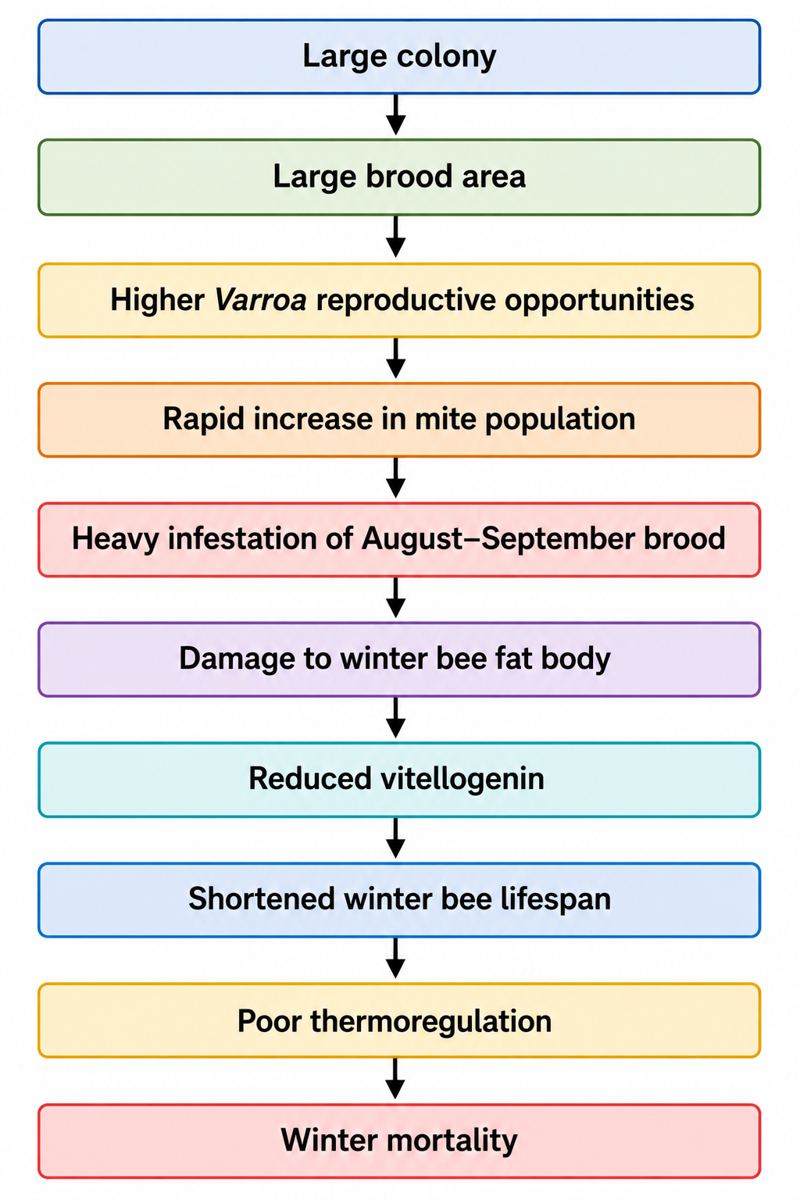
Practical Implications for Beekeepers
The evidence supports several important management principles:
- Do not judge Varroa levels by colony strength. Large colonies can harbour very high mite populations while appearing vigorous.
- Monitor mites quantitatively (e.g. alcohol wash or sugar shake) in mid- to late summer rather than relying on visual signs.
- Treat before or during the onset of winter bee production so that August–September brood develops with minimal mite exposure.
- Reduce reinfestation risk, especially in apiaries with many colonies by simultaneous monitoring and treatment where possible.
- Aim to protect the physiological quality of winter bees, not simply to maximize colony size entering winter.
Overall conclusion on varroa
The consensus from experimental and field studies is that winter survival is determined less by the number of bees present in autumn than by the physiological quality of the winter bees produced during August and September. Large colonies provide abundant brood that accelerates Varroa population growth. If mite populations are not reduced before winter bee production begins, these colonies may appear exceptionally strong in late summer while simultaneously producing a cohort of compromised winter bees with reduced longevity. The result is the characteristic pattern of sudden winter collapse despite an apparently healthy colony only weeks earlier.
Although the bee population is decreasing the varroa load continues to rise exponentially and the untreated colony can soon be overwhelmed, with fatal results. Apart from weakening the adult bees and shortening their lives, varroa can cause them to suffer from a variety of serious virus infections including Deformed Wing Virus (DWV),
Treatment
For treating the mites in the reproductive phase there are numerous approved products on the market, some containing natural ingredients such as Formic Acid, Thymol and essential oils. Others are composed of manufactured chemicals including Amitraz, Flumethrin and Tau Fluvalinate. Artificial or ‘hard’ chemicals are effective but carry the risk of the varroa developing resistance and can accumulate in the comb.
Whilst Formic Acid treatments are said by some to be tough on the queens or cause excessive losses, all the authorized brands are safe to use if the manufacturer’s instructions are followed to the letter, especially regarding dosage, temperature and ventilation. All are designed to kill the mites that are feeding and reproducing inside the capped brood.
Treatment must be applied after removal of the supers containing honey for human consumption. Any supers left in place during treatment should be marked to indicate that they may contain traces of the miticide and shouldn’t be used again until the frames have been cleaned and refitted with new foundation.
A second treatment of Oxalic Acid to kill the ‘phoretic’ or dispersal phase, i.e. those living and feeding on the adult bees, is given in winter when there is little or no brood. Traditionally this was carried out in late December between Christmas and New Year, but recent research has shown that in Southern England the optimum period is now early December or even late November. Treatment is by trickling the dissolved product from a syringe, using devices such as Gas Vap which is a modified blow torch, or by sublimation with special equipment. Treatment with Oxalic Acid requires the operator and any bystanders to wear personal protective equipment.
Queens
Apart from Varroa and its attendant diseases, queen failure is probably the second most common cause of winter losses. Queens are at their most productive in the first 2 years of their life. After that their egg laying capacity declines and they are likely to be superseded. Unfortunately, by the end of summer the chances of a replacement queen being mated are diminishing rapidly and both the old and the new queen will fail to survive.
Now is a good time to introduce new, mated queens which are ready to produce the vital winter bees needed to see the colony through winter and into spring. If the old queen has good genetic traits, and you can’t bear to part with her, she can be retired into a nuc and used for emergencies such as making up winter losses, or for raising new queens next year.
Young queens in their first 2 years are less inclined to swarm the following year. Those that do make swarm preparations will pass on the trait to their offspring and their drones will spread the swarmy behaviour to other colonies in the area. The colony should be requeened as soon as practicable.
Alternatively, if colonies are allowed to swarm and the beekeeper is confident they can recover the swarm, they benefit from a brood break of 2-3 weeks which reduces the varroa population and produces new queens
Similarly, if the colony has been excessively defensive or flighty during the season, requeening now will improve the temperament of the colony and make your beekeeping a pleasure again, as well as not spreading the undesirable genes to other beekeepers’ stock by its drones.
Like humans, not all queens are born equal and poorly mated or badly developed queens will fail early in their lives or be superseded.
Pests and predators
Mouse guards and woodpeckers. Mice are sometimes tempted into hives at the start of winter by the prospect of a warm home in which to hibernate. Mouse guards fitted in October will deny them access. In a hard winter when there is little food available, green woodpeckers will drill holes in the side of hives and raid the contents causing considerable damage and often leaving the colony to die of cold or starvation. A cage of chicken wire around the hives will prevent the birds from attacking them.
Insulation
A layer of insulation in the roof of wooden hives can help to keep the cluster warm and reduce the quantity of stores they consume in order to produce heat. The winter bees are more rested and likely to live longer. Insulated hives enjoy better winter survival rates and faster spring build up. Poly hives and nucs have an advantage in this respect. (St. Clair et al 2015)7
Studies have shown that honey bees have a higher tolerance level of CO2 and humidity than varroa; hives with a high level of these have lower varroa counts. (Rassol Bahreini et al 2015)8
Summary
- A colony that is healthy and well fed, with a productive young queen, will have a better chance of getting through winter and spring.
- Bees born in June and July will die in August and September. Bees born in August and September will live until the following spring.
- Larger colonies have a larger varroa population and are more vulnerable to winter collapse than smaller ones
- Varroa treatments in late July/early August are required to protect the developing winter bees and guard against losses.
- Colonies led by young queens are much more likely to survive than those with older queens. They are also less susceptible to swarming the following spring.
- Protection against mice and woodpeckers is fitted in October.
- Insulation can make stores last longer, extend the life of the winter bees, and help the colony to grow faster in spring.
Further reading: The Beelistener – Ann Chilcott’s beekeeping site, with articles and research summaries on bee health, varroa and winter survival.
References:
- MATTILA, H.R. and OTIS, G.W. (2007), Dwindling pollen resources trigger the transition to broodless populations of long-lived honeybees each autumn. Ecological Entomology, 32: 496-505. https://doi.org/10.1111/j.1365-2311.2007.00904.x
- Mainardi, G., Sponsler, D., Minaud, E., Vardakas, F., Charistos, L., Requier, F., Hatjina, F., & Steffan-Dewenter, I. (2025). Floral diversity enhances winter survival of honeybee colonies across climatic regions. Journal of Applied Ecology, 62, 1487–1497. https://doi.org/10.1111/1365-2664.70054
- van Dooremalen C, Gerritsen L, Cornelissen B, van der Steen JJ, van Langevelde F, Blacquière T. Winter survival of individual honey bees and honey bee colonies depends on level of Varroa destructor infestation. PLoS One. 2012;7(4):e36285. doi: 10.1371/journal.pone.0036285. Epub 2012 Apr 27. PMID: 22558421; PMCID: PMC3338694.
- Martin, S. J. (2001). The role of Varroa and viral pathogens in the collapse of honey bee colonies. Journal of Applied Ecology, 38, 1082–1091.
- Knoll S, Pinna W, Varcasia A, Scala A, Cappai MG (2020).
- https://scientificbeekeeping.com/ipm-3-strategy-understanding-varroa-population-dynamics/
- St. Clair AL, Beach NJ, Dolezal AG (2022) Honey bee hive covers reduce food consumption and colony mortality during overwintering. PLoS ONE 17(4): e0266219. https://doi.org/10.1371/journal.pone.0266219
- Rassol Bahreini, Robert W. Currie, The Potential of Bee-Generated Carbon Dioxide for Control of Varroa Mite (Mesostigmata: Varroidae) in Indoor Overwintering Honey bee (Hymenoptera: Apidae) Colonies, Journal of Economic Entomology, Volume 108, Issue 5, October 2015, Pages 2153–2167, https://doi.org/10.1093/jee/tov202


Leave a comment